Hand over the house. And every answer.
Handover builds each of your clients a searchable app and a printed binder for their new home. It does the hunt for the appliance manuals, the care instructions and the warranty contacts, and hands back anything it cannot prove, named, instead of guessing at it. All of it under your name. Your client gets it free, from you.
What it takes off your desk
Fewer hours. A better handover. Every house the same.
The busywork at the end of a job stops being yours, and what your client walks away with is the same standard every time, instead of whatever that month allowed.
Hunting down the manual for a model ordered a year ago.
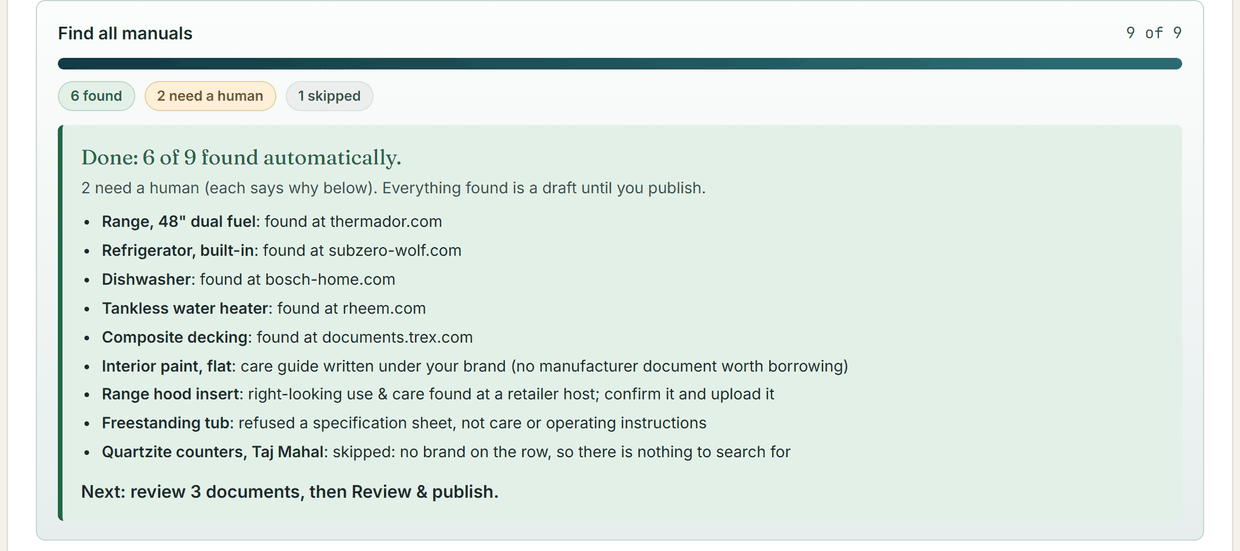
The searching stops being yours. The document for the exact model on your list arrives attached to it, and the few it cannot prove come back named, for you to confirm or upload.
Downloading, renaming and filing several hundred pages of PDFs.
No download folder to sort out. Every document lands in its section, named the same way on every house you build.
Writing care instructions for surfaces nobody in the office is an expert on.
Your client gets cleaning advice from the maker or a national trade body, not from a guess about what quartz wants.
Chasing serial numbers and trade phone numbers at the last minute.
The numbers your client would ring you for are already in their hand: every trade, and every appliance with its serial.
Laying it out so it prints like a book instead of a stack.
One file goes to the print shop and a book comes back. Cover, dividers, and page numbers that are the real ones.
The office
The other end of the job, off your desk.
Every finished house leaves the same pile behind. A drawer of manuals and install guides, creased, a few of them stained, several of them for a model that got swapped out along the way. Turning that pile into something you would be happy to hand a client is hours of office time, and it lands in the week you have the least of it.
That is the work Handover absorbs. Assembly becomes a review pass, and what your client receives looks like your company produced it on purpose, instead of looking like the drawer it came out of.
How it works
From your selection list to their front door.
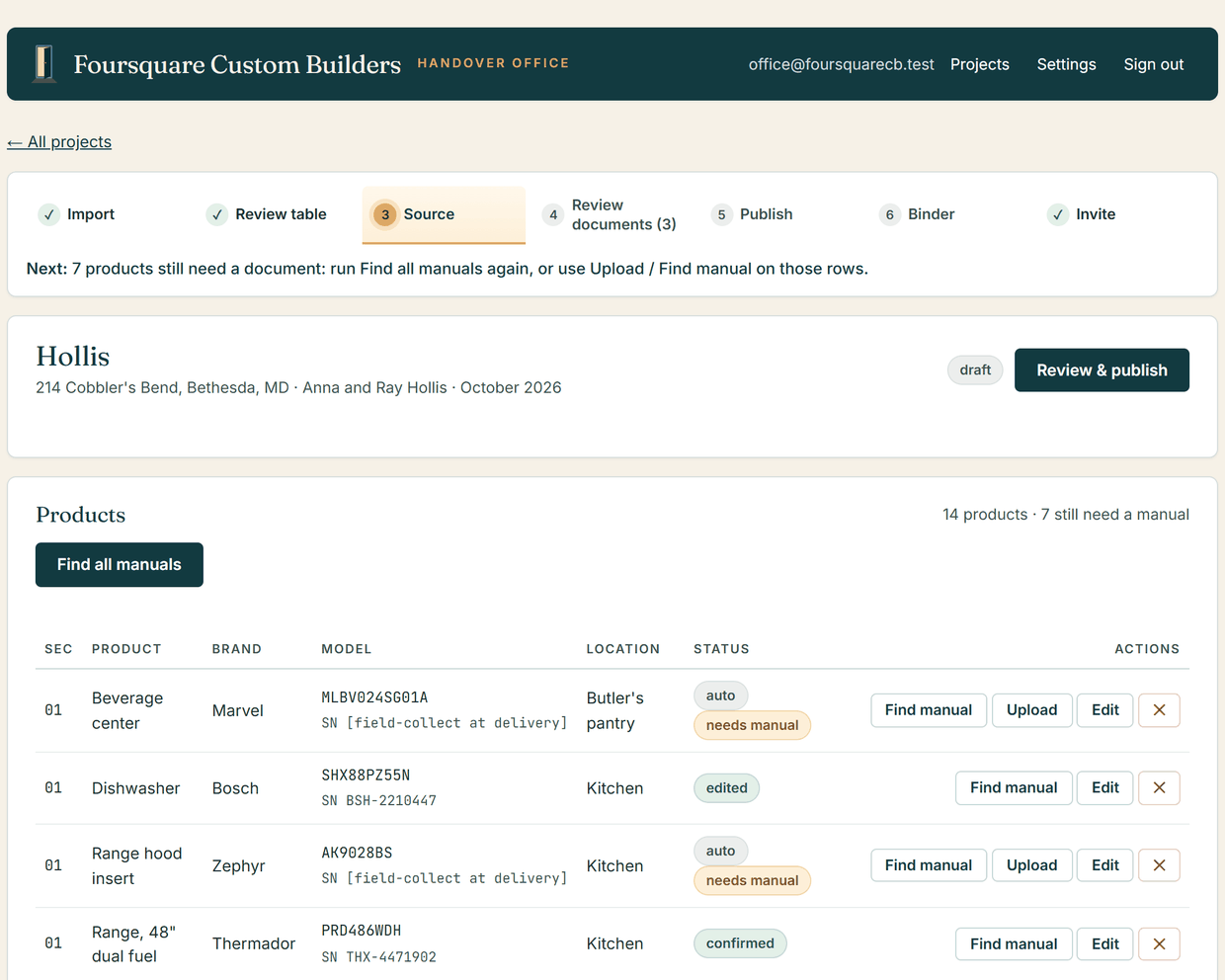
You send in what you already have. The platform does the collecting. You approve what goes out.
Send in the house
A Buildertrend selection print or a CSV. It gets read into a product list by section and room, with the makes and models pulled out, for you to look over and correct.
It goes and finds the documents
Manuals from the manufacturer for each model. Care instructions from the maker, the finish brand or a national trade body. Warranty registration pages, with the terms and deadlines each manufacturer actually states. What it cannot verify, it flags instead of guessing.
Hand it over
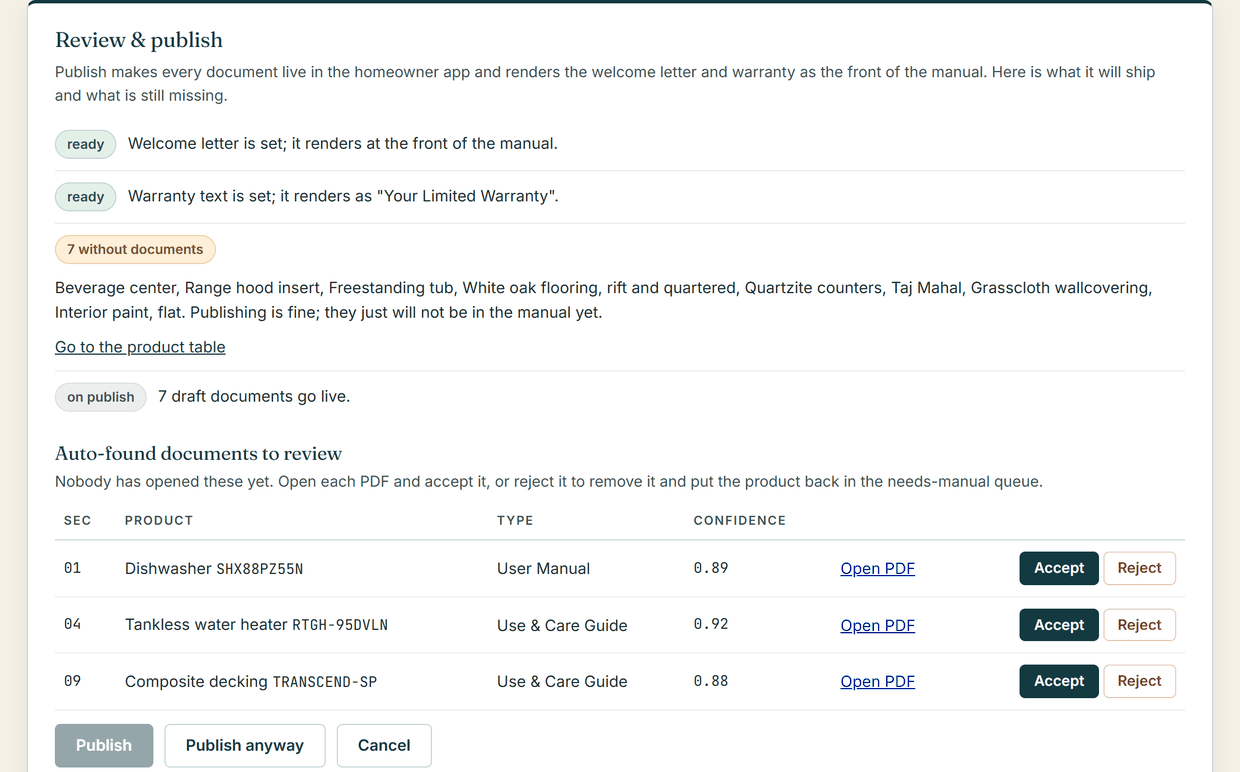
Publish, and your client's app is live that minute. Search catches up right behind it, because indexing what you just published runs as a background job. Print the binder from the same content, cover and dividers and page numbers included, and hand it across the counter with the keys.
What your client gets
One place they go with a question.
For the first time your client can look it up themselves, and what they find is right for their house. Free to them, on their phone, in your company's colors, with the book on the shelf as well.

What they open. The trades who worked on the house, by trade, with a tap to call. Then every appliance with its make, model and room, and the serial number written down at delivery instead of hunted for behind the fridge five years later.

What they ask. A real question, answered out of the manufacturer's own manual for the range in that kitchen, with the manual one tap underneath. Anything the home's documents do not support does not get answered at all.

What they keep. The house sorted into the same numbered sections as the printed binder. Open here at Surfaces, where the care guides sit: the ones found at the maker, and the ones written under your name when no maker document was worth borrowing.
No accounts to manage.
One email address is the whole job. There is no account for you to set up, no password to reset, and nobody locked out of their own house on a Saturday night. Your client has nothing to sign up for and nothing to remember: a six-digit code gets them in, they are never billed for it, and there is no account for them to keep up.
More than a folder of PDFs.
Your client also gets what to do each season, how to look after every surface in the house, and which warranties to register before the window closes. Written for their address, printed under your name.
The binder
The shelf copy, still.
A book is what your client pictures when you say you hand over a manual, and the book is what is still in the kitchen drawer fifteen years later, still looking like your company made it on purpose. Handover prints the same content it puts in the app.
- Your cover, the home, the owners and the delivery date.
- A table of contents with real page numbers, not estimates, and a printed divider for every section.
- Quick reference at the front: emergency and trade contacts, then the appliance inventory with model and serial.
- Laid out for double-sided printing so each manual starts on a fresh sheet, instead of on the back of the last one.
- One file to the print shop. Anything that would not print cleanly is listed for you rather than dropped in silence.
The answers
The answer your client reads is one you would stand behind.
The eight o'clock Sunday text message stops coming, and nothing you would have to walk back goes out in your name. A confident wrong answer about a client's water heater would be your problem, not a software company's, so this is built not to produce one.
Nothing in the book you did not vouch for.
A document reaches your client only when it came from the company that made the thing, or, for the care of a surface, from the national body for that trade: the NWFA on wood floors, the TCNA on tile, the Natural Stone Institute on stone. The right-looking manual on a reseller's site is never attached quietly: it comes back as a flag naming the host and the link, for you to settle.
Your client is never told something the house cannot back.
Every answer is audited against that home's own documents before they see it. A claim the documents do not support is not softened, it is pulled, and what they read instead is a note pointing them to you by name and phone number.
The dangerous questions come back to you.
Gas, electrical, shutoffs, temperatures, cleaning chemicals. If the specifics are not in this home's documents your client is sent to you, not to the general answer, which is often wrong for the exact model sitting in that house.
They can check it, so they trust the rest.
Every answer names the product and model it came out of, and one tap opens that manual at the right place. Your client reads the paragraph for themselves, which is what a good binder always let them do, and it is why they believe the next answer too.
Your name on it
Your client thanks you for it.
Everything they open, print and keep says your company on it, so the handover is one more thing they credit you with. This is your client relationship and we are not going to put a logo in the middle of it.
They open your company, not our software.
Give it your logo and two brand colors once. From the moment your client signs in, the app in their hand is in your palette with your name at the top of the screen.
Every printed page came from your office.
The welcome letter, the warranty, the quick reference pages, the registration guide, the care instructions and the binder cover. As far as your client can tell, you produced all of it, and nothing on the page says otherwise.
No watermark to earn your way out of.
There is no tier with our name stamped on your deliverable. Builder-first branding is not an upgrade here, it is the whole design.
Their house, and nobody else's.
Your client sees their own home and nothing else, and your projects stay yours, separate from every other builder on the platform.
Where it stands
Straight about the stage it is at.
- RunningThe platform is live in production and running real homes. The builder who makes it runs his own company's homes on it.
- Not openIt is not generally available. There is no signup on this page because there is nothing to sign up for yet.
- No priceThere is no price because there is not one yet. Nobody is being charged for this, and price is part of the first conversations.
- Early accessAsking is how you get in line. Tell us what you build and you get a real reply about where it stands and what it would take to put one of your homes in it.
Questions
Things builders ask.
Do I have to gather all the manuals myself?
No, that is the part the platform does. It searches manufacturers for the right document for each model you selected, and it attaches a document only when it came from that manufacturer's own site. Anything it cannot verify is flagged for you rather than attached, and you can upload your own PDF for any product.
What do I have to send in to set up a home?
Your selections. A Buildertrend selection print or a CSV both work. The list is read into a product list you review before anything is sourced, and you can add or correct products by hand.
What does my client have to do?
Nothing before you hand it to them. You add their email address, they get a message saying their home is ready, they type in the six-digit code emailed to them and they are in. No password, no account to create and nothing for them to pay.
Whose brand is on it?
Yours, from sign-in onward. Your logo and colors theme the app the moment your client signs in, and the welcome letter, warranty, care guides, quick reference pages and binder cover all print on your letterhead. The one screen that is ours is the sign-in screen before that: it carries the Handover name, tells your client the app is their home's owner's manual provided by their builder, and links to this site. That screen is deliberate, because someone opening a link from an email is owed a plain answer about what the app is and where it came from. Everything past it is yours.
Can it get something wrong?
It can miss, and it is built to miss out loud. A document it cannot verify is flagged for your review instead of quietly attached, and an answer the home's own documents do not support is replaced with a note pointing your client back to you by name. Publishing stops and lists every automatically found document nobody has opened yet, so a document goes out unreviewed only if you read that list and choose Publish anyway.
Does it only work for houses I just finished?
No. If you can produce the selection list and the documents, a home you handed over years ago can be built the same way. Older homes are usually more work up front because the selection data is messier.
What does it cost?
There is no price yet, which is why there is no price on this page. Handover is not generally available and nobody is being charged for it. Price is part of the first conversations, and you would be talking to the person who decides it.
Can I sign up today?
Not yet. There is no signup and no billing. Early access is a list: tell us what you build, and you get a real reply about where it stands and what it would take to put one of your homes in it.
Who makes this?
A working custom home builder. Handover started as the homeowner manual one building company outside Washington DC hands its own clients at closing, built by hand for years before it became software. That company's homes run on it today.
The next house you finish could hand itself over.
Tell us what you build and how you hand it over now. You will get a real reply about where Handover stands and what it would take to put your next client in the app, from the builder who made it.
Prefer email? info@lockten.ai
Ask for early access
This form posts with JavaScript, which is switched off in this browser. Rather than send your name and email somewhere they would end up in a web address, here is the direct line.
Tell us what you build and how you hand it over now. The same person reads it.
Four boxes. A person reads every one of these.
No newsletter and no drip sequence. We use this to write back. Privacy.